| Home | Shops | Join |
|
|
||
|
|
||||||
|
SUBCATEGORIES Featured Items (12)  Set Five Ko-Imari Kakiemon Style Polychrome Enamel Cups
 Southern Mid-Atlantic or Tidewater region walnut Chippendale chair
Shops Active In This Category
MAIN CATEGORIES
|
Henri Charles Antoine Baron (French 1816-1885)
La Rapetasseuse et son Chat
Oil on Panel, signed
Ptg. : 12.65" x 9.5" Born 1816 in Beancon, he was a pupil of his compatriot Jean Gigoux. Baron first exhibited in 1840 with two Salon paintings. Théophile Gaultier describe them as "full of feeling and color." He obtained third class medals in 1847, 1855 and 1867 (at the World Expo), the medal 2nd class in 1848 and was made a Knight of the Legion of Honour in 1859. He was known as a lithographer and illustrated many works in the romantic spirit. He specialized in the realization of friendly and happy scenes evoking the Italian Renaissance and the gallant eighteenth century in the direct line of the festivals of Watteau, Pater and Lancret, and the representations of fabrics and drapes. He was associated with the Chantilly castle decor of the Duke of Aumale. Baron died in 1885 in Geneva
J. Murday (British fl 1837-1911)
A Tri-aspect of a Topsail Trading Schooner off South Foreland (Cliffs of Dover) Oil-on-canvas; verso label: Wm. Blair, Ltd, Bethesda, Maryland
Painting: 24” x 36” Murday was an accomplished painter of ship portraits and shipping scenes whose works were often signed and dated in the second half of the 19th century. Regrettably, there is little biographical information available on this artist. His paintings are in the collections of the Greenwich National Maritime Museum, the Peabody-Essex Museum in Salem, MA, and the San Francisco National Maritime Museum. Some representative titles are: The Barque Bernard, The Schooner Ellen Gillman, and A Barque Among Icebergs off Cape Horn. Lina Krause (German,1857-19)
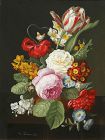
Old Master Style Still Life Oil on Panel, signed Provanance: Noortman Master Paintings, Maastrick
Painting: 9.75" x 7.25" John Charles Maggs.(British,1819 - 1896 )
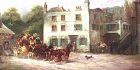
The London to Bath Coach Pulling up to the Spaniards Tavern, Bath, England in 1884 Oil on Canvas, signed, and dated l.r.
Painting: 14: x 26" A newly discovered gem from one of England's best coaching painters. John Charles Maggs (1819–1896) was a painter best known for his coaching scenes. He was born in Bath, England in 1819, his father being a furniture japanner there. John painted a series of famous coaching inns, and also a series of 80 metropolitan inns, in which he exploited the picturesque and historical aspect of his subject, to which his talent was best suited. Other subjects he painted include Newmarket Races, Robbing the Mails, The News of Waterloo, The Market Place at Bath. The period he illustrated spans about two centuries; from the days before Hogarth, to the end of the reign of William IV. His work enjoyed great popularity at a time when there was much interest in such vivid reconstruction of the 'romantic past'. John Maggs' father, James, is recorded as an artist at Bath 1837–1841 and his uncle as a portrait painter 1846–1848. His daughter also assisted at his studio, known as the Bath Art Studio. Maggs lived in Bath his whole life, and died there on 3 November 1896, aged 77. THE SPANIARDS TAVERN The Spaniards Inn is a historic pub on Spaniards Road between Hampstead and Highgate in London, England. It lies on the edge of Hampstead Heath near Kenwood House. The pub is believed to have been built in 1585 on the Finchley boundary, with the tavern forming the entrance to the Bishop of London's estate—an original boundary stone from 1755 can still be seen in the front garden. Opposite it there is a toll house built in around 1710. would lead to more and faster traffic. Dick Turpin is thought to have been a regular at the Inn, as his father had been its landlord.What is certain is that highwaymen frequented this area and likely used the Inn to watch the road; at that time the Inn was around two hours from London by coach[citation needed] and the area had its fair share of wealthy travellers. Records from the Old Bailey show that on 16 October 1751 Samuel Bacon was indicted for robbery on the King's Highway and was caught 200 yards from the Spaniards In 1780 rioters involved in the Gordon Riots, opposed to the relaxation of laws in England that restricted Catholicism, marched on Hampstead intent on attacking Kenwood House, the home of William Murray, 1st Earl of Mansfield. The landlord of the Spaniards at the time is reported to have given them free drinks, keeping the rioters occupied, until the local militia arrived, thus saving the house. The pub has been mentioned in Dickens's The Pickwick Papers and Bram Stoker's Dracula, and has been frequented by the artist Joshua Reynolds and the poets Byron and Keats. According to the pub, Keats wrote his Ode to a Nightingale in the gardens, and Stoker borrowed one of their resident ghost stories to furnish the plot of Dracula.
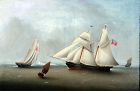
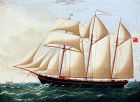
Portrait of the British Schooner "ESTHER"
Oil on canvas, 19th century Signed indistinctly lower right "Wm Mc *****" and dated
Painting: 21" x 28.5" Ship portraits, such as this, were commissioned by the new owner often time itinerant artists who traveled around different boat builders looking for work. They documented exactly what the ship looked like with full sails, flags and rigging so if a boat was lost at sea the portrait could be presented to their insurance agent.
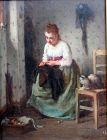
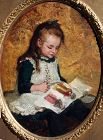
French School,
Late 19th/early 20th Century
Young Girl with Paper Dolls Oil-on-canvas, Unsigned
Oval: 19” x 14 ¼” This charming study of a young girl intent on cutting out paper dolls is reminiscent of works by Berthe Morisot, Mary Cassatt and Pierre-Auguste Renoir (his earlier works). She is beautifully captured with her rosebud lips, her hair tied up in a bow, a lacy pinafore over her navy dress and stockinged legs dangling. Set against a textured backdrop, her figure seems perfectly set apart, in her own world.
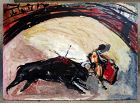
Jaume Muxart I Domènech
(Spanish, 1922-2019)
Bullfight Acrylic on panel, signed Painting: 13 ¾” x 19 ½” Muxart was a Catalan painter, part of the Grup Taüll of avant-garde artists. His work shows a strong expressionist character with structured figurative motifs. Muxart was of a generation of artists that developed during the years of the Franco regime. In 1948 he got a grant to study in Paris, where he met Picasso and decided to devote his life to art. A grant in 1952 saw him travel to Rome. When Muxart returned home, he helped set up the Grup Taüll with six other artists (Marc Aleu, Modest Cuixart, Josep Guinovart, Jordi Mercadé, Jaume Muixart, Antoni Tàpies and Joan Josep Tharrats) in 1955. Yet, as an artist, Muxart was something of a free spirit, a value he passed on to his students at the Fine Arts faculty in Barcelona University, where he taught and would later become dean. Muxart never stopped exhibiting his work, both in Spain and abroad. In fact, his work was displayed all over the world in exhibitions in cities that included Cairo, Stockholm, London, Sao Paulo, Copenhagen, and New York.
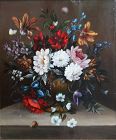
Dirk Ocker
(Dutch, 1882-1958)
Blossoms and Bugs Oil-on-canvas, signed on reverse
Painting: 20 ¼” x 17 ¾” Henry Maidment (British, fl. 1889-1914)
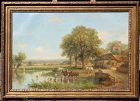
Farm by a Pond Oil on canvas, signed lower right
Painting: 24" x 30" Maidment was a painter in oil of rural scenes and landscapes. He also used the pseudonyms of "R. Fenson" and “A. Wynn”. Dated examples of his work have been seen spanning from 1898 until 1914. The high quality of the painting and decorative subject matter have fueled an ever growing demand for Maidment’s work.
Source: Johannes Marinus Ten Kate (Dutch, 1859-1896)
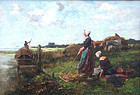
Working the Field Oil on canvas. signed lower right
Painting17" x 24 3/4" Ten Kate was known for his landscapes, beach scenes and genre paintings. Born in Amsterdam, he was the son of Johannes Mari ten Kate, under whom he most likely studied. He lived and worked in the Hague and was a member of the Hague Artists’ Society and the Pulchri Studio (latin:"for the study of beauty"), a Dutch art society, art institution and art studio based in the Hague. The countryside around the coastal town of the Hague provided a rural environment and an unspoiled landscape which attracted many young artists of the nineteenth century eager to escape the strictures of academic art guilds.
STUDIO ANTIQUES & FINE ART, INC.
$35,000 Harriette F A Sutcliffe (British, fl.1881 - 1922)
Beauty and the Beast Oil on canvas, signed with monogram and titled on the reverse Exhibited: The Royal Academy, 1899 Miss Suitcliff was a Hampstead painter of genre and portraits who exhibited at the royal academy from 1881-1899 and elsewhere. Source: Christopher Wood, The Dictionary of Victorian Painters Painting Size: 16" x 20" Frame Size: 24" x 28" Richard Redgrave (British, 1804-1888)
Resting Deer in a Forest Landscape Oil on canvas Provenance: Thomas McLean Gallery, London (retaining the original label on the back).
Painting: 20.75" x 36" Redgrave was a genre and landscape painter. For a time he worked with his father who was an engraver before entering the Royal Academy in 1825. He began by painting historical genre in 18th century costume but in the 1840s he was among the first to depict contemporary social subjects in contemporary clothing (“The Seamstress”, “Bad News from the Sea”, “The Governess”). In 1836 he finally gained wider audience with his painting of “Gulliver on the Farmer’s Table”. Redgrave was involved with the organization of the Government School of Design (1847) as well as the first keeper of paintings at the South Kensington Museum (now known as the Victoria and Albert museum). He was Inspector of the Queen’s Pictures and co-author with his brother Samuel of “A Century of Painters of the English School”, still a valuable book on English art. Redgrave exhibited some 175 works at the Royal Academy from 1824-1883, the British Institution, the Society of British Artists and others. Several of his paintings are in the Victoria and Albert museum, the National Portrait Gallery (London) and the Shipley Art Gallery (Gateshead). Retiring from his many offices in 1880 due to ill health, Redgrave’s later work was mostly painted while summering at his country house, primarily landscapes painted in a pre-Raphaelite style.
Sources: John Henry Smith (British, fl.1852-1893)
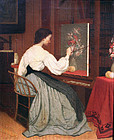
An Artist at Work Oil-on-canvas, signed lower left and dated “1863”
Painting Size: 22.25” x 18” This charming portrait of a young woman artist at work is a wonderful depiction of the painter and her tools. Her subject of a vase of flowers with fruit sits on a table to her right. The sturdy adjustable easel has a shelf where she has laid out her tubes of pigments. She is using a mahl stick to create a bridge across the canvas which supports her painting hand to avoid touching the surface. An artist’s apron lays across her lap to protect her skirt. Her full concentration is on the canvas in front of her which is nearing completion. J. Henry Smith was a painter of genre, landscapes and animals, living in London, Brixton and South Lambeth who exhibited extensively from 1852-1893 at the royal Academy, the British Institution, the society of British Artists and elsewhere. Titles exhibited at the Royal Academy included “Where the Shoe Pinches” (1882) and “A Book is the Best Solitary Companion in the World” (1885).
Sources: English School, early 19th century
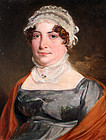
Portrait of a Woman in Lace Cap Oil on panel. Provenance: J. Davey & Sons, Manchester, England
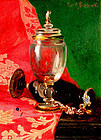
Painting size: 8.5” x 7” Tabletop Still Life with Glass Vases
Henri Dominique Roszezewski (French, 19th/20th century) Oil on panel, signed. A painter of landscapes and still lifes, Roszezewski studied under Maillard. He made his debut at the Salon de Paris in 1868 and was particularly noted for his still life paintings.
Roszezewski is listed in Dictionnaire des Peintres, Sculpteurs, Dessinateurs, et Graveurs by Bénézit.
Painting size: 8.5” x 6.25” John White
(English, 1851-1933)
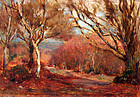
Woodland Fall Landscape Oil on panel, signed in lower left corner, “JN White, R.I.”
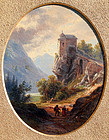
Painting size: 6.75” x 10” Known for his rustic genre paintings and landscapes, White attended the Royal Scottish Academy. By 1877, he moved to Devon and exhibited regularly at the Royal Academy, the Society of British Artists, Suffolk Street and the New Watercolor Society. On this landscape, White painted the initials “R.I.” after his name, indicating that he was a Member of the Royal Institute of Painters in Watercolors. Although this work is in oil, White’s scumbled brushwork has the immediacy of watercolor and creates the atmospheric haze of a fall afternoon. John White was also a Member of the Royal Institute of Painters in Oil-Colors. He is listed in The Dictionary of British Watercolor Artists up to 1920 (Mallalieu, 1976) and the Dictionary of British Art, Volume IV Victorian Painters (Wood, 1995). Travelers in an Alpine Landscape
Swiss or German School, circa 1860. Oil on paper, with a gilt sand mat.
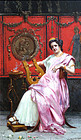
Painting Size: 6” x 4.5” Oval Jose Rico y Cejudo (Spanish, 1864-1939)
Classical Figure with a Lyre Oil on Panel, signed and retaining a paper label on the reverse
Painting: 14.5" x 8.5" Jose Rico y Cejudo was born n Seville, Spain on March 27, 1864. He was the student of M. Ussel and J. Garcia Ramos at the School of Fine Arts in Seville. Eduardo Cano also played a role in the education of Cejudo as Cejudo would often pay visits to the artist'a studio. In 1888 he received a scholarship to study painting in Rome for seven years. While there, he made visits to the studios of his fellow countrymen Jose Villegas and Jose Gallegos. After his experiences in Rome, he returned to work in southern Spain. Cejudo taught art classes at the School of Fine Arts in Malaga from 1905. He exhibited his work and won various medals, such as a first place medal at Grenada in 1902, and a medal at the National Society of Fine Arts in 1910. Cejudo specialized in painting "anecdotal scenes from everyday life, often portraying his figures in gardens, patios and other intimate spaces. His paintings are characterized by a bright luminous palette." Some of his works are held in museum collections in Cadiz, Spain: London England and Madrid and Seville, Spain.
Sources:
| |||||||||||