| Home | Shops | Join |
|
|
||
|
|
||||||
|
SUBCATEGORIES Featured Items (12)  A Sheraton mahogany cellarette. White pine secondary. Bale handles
 Chippendale mahogany pie crust tilt top trifid wine or tea table
Shops Active In This Category
MAIN CATEGORIES
|
STUDIO ANTIQUES & FINE ART, INC.
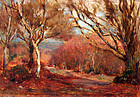
Now on View in Our Gallery Benson Bond Moore
(American 1882-1974)
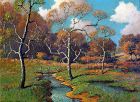
"Stream in Autumn, near Bethesda MD." Oil on board, signed lower left and titled on the reverse
Painting: 12" x 16" SAFA/10945 Provenance: The Estate of a Toms River Collector Benson Bond Moore, painter, etcher and teacher was born in Washington, DC. He studied at the Corcoran School of Art with Messer and Brooke , and also with Weyl . He continued his studies in drawing at the Linthicum Institute under Ballenger and learned painting conservation from his father. Active in professional societies, he was a member and officer of the Landscape Club of Washington. He was also a longtime member of the Society of Washington Artists. He exhibited with both groups from as early as 1915 and continued through the 1930's. His work was also shown at the Corcoran Gallery of Art. As an artist, he became well known and honored for his local scenes, many of which are in major public collections. His works are held by the National Museum of American Art; Historical Society of Washington, DC; Library of Congress; The White House; Bibliothèque National de Paris; Cosmos Club; National Museum of American History; the Houston Museum of Fine Art and the Los Angeles Museum of Art. Over his life, he was honored with numerous awards for his work.
Sources: Johannes Marinus Ten Kate (Dutch, 1859-1896)
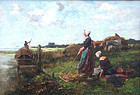
Working the Field Oil on canvas. signed lower right
Painting17" x 24 3/4" Ten Kate was known for his landscapes, beach scenes and genre paintings. Born in Amsterdam, he was the son of Johannes Mari ten Kate, under whom he most likely studied. He lived and worked in the Hague and was a member of the Hague Artists’ Society and the Pulchri Studio (latin:"for the study of beauty"), a Dutch art society, art institution and art studio based in the Hague. The countryside around the coastal town of the Hague provided a rural environment and an unspoiled landscape which attracted many young artists of the nineteenth century eager to escape the strictures of academic art guilds.
STUDIO ANTIQUES & FINE ART, INC.
$35,000 Harriette F A Sutcliffe (British, fl.1881 - 1922)
Beauty and the Beast Oil on canvas, signed with monogram and titled on the reverse Exhibited: The Royal Academy, 1899 Miss Suitcliff was a Hampstead painter of genre and portraits who exhibited at the royal academy from 1881-1899 and elsewhere. Source: Christopher Wood, The Dictionary of Victorian Painters Painting Size: 16" x 20" Frame Size: 24" x 28" August H.O. Rolle (American 1875-1941)
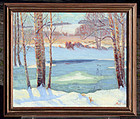
River Birches Oil on Canvas, Signed lower right and titled and signed on reverse
Painting: 20" x 24" ** For other paintings by artists from Maryland, Virginia, Washington DC or North Carolina, click on the “Regional Artists” button on our Homepage. August Herman Olson Rolle, painter, printmaker and graphic artist, dabbled in many activities before turning his focus to art. Born in Sibley County, MN, in 1875, his first path toward adulthood led him to Red Wing Seminary. Service in the Spanish-American War, eventually lead him to Washington, DC where he became a forestry expert for the Census Bureau. Once in Washington, Rolle studied at the Corcoran School of Art under Messer, Brooke and Moser beginning in 1905. His specialties were landscapes and seascapes in oil and watercolor, but he also executed dryprints, woodblock prints, monotypes and etchings. Following the tradition of his day, Rolle was active in many art societies. In addition to helping found the Landscape Club of Washington in 1915, he served as its president for many years. That was just one among a number of affiliations which also included the Sculptors and Gravers Society of Washington, the American Federation of Arts, and the Arts Club of Washington. Rolle also exhibited at the Corcoran Gallery of Art, the old National Gallery, the Maryland Institute and at the Greater Washington Independent Exhibition of 1935. He had a joint exhibition of prints with fellow artist Benson B. Moore at Venable's Gallery in 1924. Rolle died in Washington, DC in 1941. Today, his work is represented at the Corcoran Gallery, the Historical Society of Washington, DC, and the Arts Club of Washington. A retrospective of his work was held at the Corcoran's 1982 "Washington on the Potomac" and at the National Museum of American Art's 1984 show "The Capitol Image."
Sources: Richard Redgrave (British, 1804-1888)
Resting Deer in a Forest Landscape Oil on canvas Provenance: Thomas McLean Gallery, London (retaining the original label on the back).
Painting: 20.75" x 36" Redgrave was a genre and landscape painter. For a time he worked with his father who was an engraver before entering the Royal Academy in 1825. He began by painting historical genre in 18th century costume but in the 1840s he was among the first to depict contemporary social subjects in contemporary clothing (“The Seamstress”, “Bad News from the Sea”, “The Governess”). In 1836 he finally gained wider audience with his painting of “Gulliver on the Farmer’s Table”. Redgrave was involved with the organization of the Government School of Design (1847) as well as the first keeper of paintings at the South Kensington Museum (now known as the Victoria and Albert museum). He was Inspector of the Queen’s Pictures and co-author with his brother Samuel of “A Century of Painters of the English School”, still a valuable book on English art. Redgrave exhibited some 175 works at the Royal Academy from 1824-1883, the British Institution, the Society of British Artists and others. Several of his paintings are in the Victoria and Albert museum, the National Portrait Gallery (London) and the Shipley Art Gallery (Gateshead). Retiring from his many offices in 1880 due to ill health, Redgrave’s later work was mostly painted while summering at his country house, primarily landscapes painted in a pre-Raphaelite style.
Sources: Peter Paul Duggan (Irish/American 1810 ? -1861)
Macbeth Oil on artist board Provenance: Sycamore Farm, Portsmouth, VA (Estate of Robert Vick and Charles Sibley) Note: Listed in "The National Academy of Design Exhibition Record 1861-1900" page 249, number 482.
Painting Size: 6 ½” x 6 ½” Born in Ireland, Duggan was brought to the United States as a young child, probably around 1810. He was a student at the National Academy of Design from approximately 1842-1849. He was a frequent exhibitor at the National Academy as well as at the Pennsylvania Academy of Fine Art. Duggan was known to have exhibited works at the Academy (1844-51) which were religious and historical in nature although he was admired by his contemporaries as a portraitist in charcoal and crayon - undoubtedly the source of his livelihood. Later works exhibited (1855-56) were portraits only. He also sculpted several medals for distribution by the American Art-Union. In the late 1840’s Duggan was a professor of drawing at the Free Academy of New York (later the City College of New York). Duggan suffered from tuberculosis and retired in 1856 at which time he went to live in London with relatives. In the spring of 1861 he went to Paris for what was intended to be an extended stay but was there only until October when he succumbed to his illness.
Sources: John Henry Smith (British, fl.1852-1893)
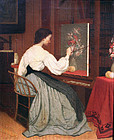
An Artist at Work Oil-on-canvas, signed lower left and dated “1863”
Painting Size: 22.25” x 18” This charming portrait of a young woman artist at work is a wonderful depiction of the painter and her tools. Her subject of a vase of flowers with fruit sits on a table to her right. The sturdy adjustable easel has a shelf where she has laid out her tubes of pigments. She is using a mahl stick to create a bridge across the canvas which supports her painting hand to avoid touching the surface. An artist’s apron lays across her lap to protect her skirt. Her full concentration is on the canvas in front of her which is nearing completion. J. Henry Smith was a painter of genre, landscapes and animals, living in London, Brixton and South Lambeth who exhibited extensively from 1852-1893 at the royal Academy, the British Institution, the society of British Artists and elsewhere. Titles exhibited at the Royal Academy included “Where the Shoe Pinches” (1882) and “A Book is the Best Solitary Companion in the World” (1885).
Sources: William Richardson Tyler (American 1825-1896)
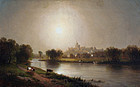
Misty Morning at Windsor Castle Oil-on-canvas, signed lower left
Painting Size: 18.5”” x 29.5” **Please Note: This item is not currently on view in our gallery. Please call at least 48 hours in advance if you wish to see it. Tyler is known to have lived and worked in Troy, NY during the 1850‘s and 60‘s where, aside from Abel Buell Moore, he was Troy’s best known artist. According to William Gerdts “Troy was a prosperous industrial and commercial city. It was also a major center of education in the 19th century. Tyler had gone to Troy to work for the carriage company of Eaton and Gilbert. In 1858 Tyler opened his own painting studio (and he) painted the local landscape but was more drawn to the sea. He specialized in scenes off the coast of Long Island and Massachusetts.” It is apparent from the record of his works that he traveled extensively in Europe painting scenes in Venice and scenes in England such as this luminist view of Windsor Castle. Tyler also painted the landscapes of the White Mountains (NH) and the Keene Valley in the Adirondacks of New York. Tyler exhibited at the National Academy of Design (1862-1867 and 1878) and his work “Breezy Day Off Boston Light” is held by the Troy Public Library. Sources: English School, early 19th century
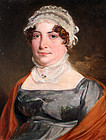
Portrait of a Woman in Lace Cap Oil on panel. Provenance: J. Davey & Sons, Manchester, England
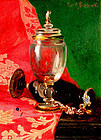
Painting size: 8.5” x 7” Tabletop Still Life with Glass Vases
Henri Dominique Roszezewski (French, 19th/20th century) Oil on panel, signed. A painter of landscapes and still lifes, Roszezewski studied under Maillard. He made his debut at the Salon de Paris in 1868 and was particularly noted for his still life paintings.
Roszezewski is listed in Dictionnaire des Peintres, Sculpteurs, Dessinateurs, et Graveurs by Bénézit.
Painting size: 8.5” x 6.25” John White
(English, 1851-1933)
Woodland Fall Landscape Oil on panel, signed in lower left corner, “JN White, R.I.”
Painting size: 6.75” x 10” Known for his rustic genre paintings and landscapes, White attended the Royal Scottish Academy. By 1877, he moved to Devon and exhibited regularly at the Royal Academy, the Society of British Artists, Suffolk Street and the New Watercolor Society. On this landscape, White painted the initials “R.I.” after his name, indicating that he was a Member of the Royal Institute of Painters in Watercolors. Although this work is in oil, White’s scumbled brushwork has the immediacy of watercolor and creates the atmospheric haze of a fall afternoon. John White was also a Member of the Royal Institute of Painters in Oil-Colors. He is listed in The Dictionary of British Watercolor Artists up to 1920 (Mallalieu, 1976) and the Dictionary of British Art, Volume IV Victorian Painters (Wood, 1995). Charles A. Watson (American, 1857-1923)
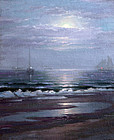
Moonlight on the Chesapeake Oil on canvas, signed lower right
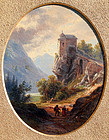
Painting size: 12” x 10” ** For other paintings by artists from Maryland, Virginia, Washington DC or North Carolina, click on the “Regional Artists” button on our Homepage. Watson was born in Baltimore, MD. He studied with A. Castaigne, E.S. Whiteman and D. Woodward. A founding member of the Baltimore Charcoal Club, he was also a member of the Baltimore Watercolor Club. Watson exhibited at the Pennsylvania Academy of the Fine Arts Annual Exhibition in 1906. He is noted for his Tonalist marine paintings where the softly dawnlit skies blend with the pale ocean waters, often with a bare outline of a sailboat. Source: From the Estate of Antoinette Hughes, Catonsville, MD Travelers in an Alpine Landscape
Swiss or German School, circa 1860. Oil on paper, with a gilt sand mat.
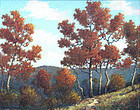
Painting Size: 6” x 4.5” Oval Benson Bond Moore (American,1882-1974)
Autumn in the Blue Ridge Mountains (near Emmittsburg, PA[sic]) 1955 Oil on board, signed lower left and dated “1955”. Titled on the reverse
Painting Size: 15.5” x 19.5” ** For other painting by artists from Maryland, Virginia or Washington DC, click on the "Regional Artists" button on our homepage Benson Bond Moore, painter, etcher and teacher was born in Washington, DC. He studied at the Corcoran School of Art with Messer and Brooke , and also with Weyl . He continued his studies in drawing at the Linthicum Institute under Ballenger and learned painting conservation from his father. Active in professional societies, he was a member and officer of the Landscape Club of Washington. He was also a longtime member of the Society of Washington Artists. He exhibited with both groups from as early as 1915 and continued through the 1930's. His work was also shown at the Corcoran Gallery of Art. As an artist, he became well known and honored for his local scenes, many of which are in major public collections. His works are held by the National Museum of American Art; Historical Society of Washington, DC; Library of Congress; The White House; Bibliothèque National de Paris; Cosmos Club; National Museum of American History and the Los Angeles Museum of Art. Over his life, he was honored with numerous awards for his work.
Sources:
Consentino, Andrew and Glassie, Henry, The Capital Image, Painters in Washington, 1800-1915 Jose Rico y Cejudo (Spanish, 1864-1939)
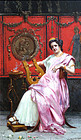
Classical Figure with a Lyre Oil on Panel, signed and retaining a paper label on the reverse
Painting: 14.5" x 8.5" Jose Rico y Cejudo was born n Seville, Spain on March 27, 1864. He was the student of M. Ussel and J. Garcia Ramos at the School of Fine Arts in Seville. Eduardo Cano also played a role in the education of Cejudo as Cejudo would often pay visits to the artist'a studio. In 1888 he received a scholarship to study painting in Rome for seven years. While there, he made visits to the studios of his fellow countrymen Jose Villegas and Jose Gallegos. After his experiences in Rome, he returned to work in southern Spain. Cejudo taught art classes at the School of Fine Arts in Malaga from 1905. He exhibited his work and won various medals, such as a first place medal at Grenada in 1902, and a medal at the National Society of Fine Arts in 1910. Cejudo specialized in painting "anecdotal scenes from everyday life, often portraying his figures in gardens, patios and other intimate spaces. His paintings are characterized by a bright luminous palette." Some of his works are held in museum collections in Cadiz, Spain: London England and Madrid and Seville, Spain.
Sources: American School, Early 19th Century
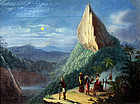
Carib Indians Around a Jungle Campfire, with a Piton in the Background Oil on canvas, signed indistinctly on the stretcher. Mid 19th century carved wood, compo and gilt frame
Painting Size: 9.25” x 12” James Francis O’Brien (American, 1917-1996)
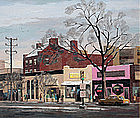
Bethesda Oil on canvas, signed lower left and titled on the reverse. Painting size: 20” x 24” Frame size: 25.5” x 29” ** Please Note - This painting came directly from the Estate of Mr. O’Brien. For other examples, type “O’Brien” into the search box. ** For other paintings by artists from Maryland, Virginia, Washington DC or North Carolina, click on the “Regional Artists” button on our Homepage. Born in Newtonville, Massachusetts, O’Brien exhibited a love of drawing and painting from a very early age. As a high school student, he took all possible elective courses in art and technical drawing. He supplemented this study with evening courses at M.I.T. Following his move to Washington, DC as a young man, he enrolled in the Washington Workshop of the Arts. WWA, like the Art Students League in New York City, was a school in which all the classes were taught by a rotating roster of professional artists. During WW II, his technical artistic training served his country well when he was put to work as a map maker. In the final year of the war, O’Brien married. On his honeymoon in New York City, he found time to paint the rooftop view from his hotel room window. This initiated a lifelong pursuit of city painting (his family was inclined to call it an obsession). Starting with the founding of Federal Graphics, a commercial art firm he launched with a partner in 1947, he pursued a commercial career for the majority of his life. However, he always considered painting his “real” work, and his dedication to this vocation was apparent in a myriad of ways. He helped to found the Montgomery County Art Association and held memberships in the Arts Council of Montgomery County and American Art League. Throughout his life, he exhibited widely, both as an individual and in group shows. The Arts Club of Washington, Corcoran Gallery of Art, Brooklyn Museum of Art, Montgomery College, and the Rehoboth Art League were a few among the many venues at which his works were shown. In addition, he exhibited in several private galleries. During the course of his painting, O’Brien noticed that the paints on his palette sometimes mixed into designs as interesting as those more deliberately created. From this observation arose the text, Design By Accident, first published in 1968. The book became widely used by art teachers following very favorably reviews by newspapers and magazines. It was even reviewed by Scientific American from a technological-aesthetic. A draftsman, illustrator, writer and most importantly painter, O’Brien was fortunate to have his work recognised and appreciated during his life. He won awards from The Montgomery County Art Association, Rehoboth Art League and American Art League. Even art critics praised his work with the most succinct calling his paintings, “familiar scenes, fresher and lighter than life”. (Florence Berryman of The Washington Star) O’Brien believed that the “creative urge” was something all children have. However, as adults, that impulse falls victim to ever growing demands and responsibilities. He maintained that artists are able to keep alive the childlike ability to see beauty and mystery in commonplace things. Thanks to his sense of wonder, he left us deeply in his debt. His paintings remind us that every day that Washington, DC is full of inspiring sights that fall outside of the traditional “glamour” views depicted by most artists.
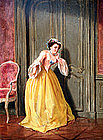
Eavesdropping
Oil on panel, signed and dated: “1865.”
Painting size: 9” x 6.75” Petrus Theodorus Van Wyngaerdt (also spelled Wyngaerdt or Wijngaerdt) was born in Rotterdam. A student of J.H. Van de Laar, he painted genre scenes and portraits, as did his older brother, painter Anthonie Jacobus Van Wyngaerdt. In "Eavesdropping", Van Wyngaerdt depicts a well-known theme from popular 19th-century French and Dutch prints-- a Roccoco figure listening at a door while a private conversation (or event) is underway. The women’s yellow skirt, pink bodice and lacy cap suggest that she is a lady (of sorts) and her plump arms, pretty features and sly expression suggest what may be going on behind closed doors. Van Wyngaerdt’s work can be found in the collections of the Haarlem Museum. He is listed in Dictionnaire des Peintres, Sculpteurs, Dessinateurs et Graveurs (Bénézit, 1999).
| |||||||||||