| Home | Shops | Join |
|
|
||
|
|
||||||
|
SUBCATEGORIES Featured Items (12)  Continental or colonial sculpted and painted wood Santos. Crystal eyes
 A strongly carved iron sukashi Kinai tsuba depicting a coiled dragon
Shops Active In This Category
Spoils of Time (7)
MAIN CATEGORIES
|
Architectural : Interior : Pre 1800
item #1493641
(stock #11259)
STUDIO ANTIQUES & FINE ART, INC.
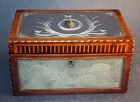
Price on Request Extremely Rare if not unique, 18th C. Georgian Tea Caddy with cut glass mirrored panels on three sides and the top and with striped inlay on the lid and zebra striped edging. The hinged lid opens to three divided compartments. Circa 1760.
8.5" x 5" x 4.5"tall
STUDIO ANTIQUES & FINE ART, INC.
$35,000 Harriette F A Sutcliffe (British, fl.1881 - 1922)
Beauty and the Beast Oil on canvas, signed with monogram and titled on the reverse Exhibited: The Royal Academy, 1899 Miss Suitcliff was a Hampstead painter of genre and portraits who exhibited at the royal academy from 1881-1899 and elsewhere. Source: Christopher Wood, The Dictionary of Victorian Painters Painting Size: 16" x 20" Frame Size: 24" x 28"
STUDIO ANTIQUES & FINE ART, INC.
$14,500
Adam Emory Albright
(American 1862-1957 )
The Valley Oil-on-canvas, signed lower right and dated 1916 Exhibited: The Art Institute of Chicago, "Pictures of Children Painted in South America and Southern California by Adam Emory Albright, 1920, #29”
Painting: 24” x 30” Albright, born in Wisconsin, was, according to William Gerdts (Art Across America, Vol. 2), “The finest Paris trained figure painter to emerge immediately before the World’s Columbian Exposition.” He was one of the first students at the newly established Art Institute of Chicago from 1881-1883. From 1883-1886, he studied with Thomas Eakins at the Pennsylvania Academy of Fine Arts. After some training in Munich with fellow Wisconsin artist, Carl Marr, Albright studied in Paris with Benjamin Constant. In 1888, Albright established his studio in Chicago and became president of the Chicago Watercolor Club as well as a member of the Chicago Academy of Design. Early in his career, he chose to focus on paintings of children for which he became famous. At first specializing in street urchins and rustic children in outdoor settings, his work became more colorful and sun-filled following his greater exposure to impressionism at the Columbian Exposition. The birth of Albright’s twin sons in 1897 gave him new models and his subsequent work featured the growing boys posed in rural surroundings. From 1908, many of his finest works were painted during summers at the art colony in Brown County, Indiana. Albright’s popularity is reflected in his numerous exhibitions and in the extensive contemporary literature about him. Again according to Gerdts, “No other Chicago artist’s work was so widely exhibited at the Art Institute . . .”
STUDIO ANTIQUES & FINE ART, INC.
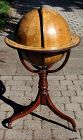
$14,500 LATE GEORGE III W.&T.M. BARDIN 18-INCH TERRESTRIAL GLOBE ON STAND
additions to 1807, dedicated to Sir Joseph Banks, the globe in etched brass frame resting on a corona with months and zodiac on turned support with tapering downswept legs with brass casters
Dimensions: Height: 41 in. (104.1 cm.), Diameter: 24 in. (61 cm.) This terrestrial globe is supported on a wooden tri-pod pedestal, surrounded by a wooden horizon circle, and it is equipped with a brass meridian . The cartouche in the Pacific Ocean displays a seated female figure of Britannia, a seated woman holding an astronomical quadrant, and a small portrait of Joseph Banks. The text below reads: “To the Rt Honorable / SIR JOSEPH BANKS, BART K. B. / This New British Terrestrial Globe / containing all the latest Discoveries and Communications, from the most / correct and authentic Observations and surveys, to the year 1798 / by Captn Cook and more recent Navigators, Engraved on / an accurate Drawing by Mr Arrowsmith Geographer / Is respectfully dedicated / by his most obedient hble servants / W. & T. M. Bardin / 230” A text below reads: “Manufactured & Sold Wholesale & Retail by W. & T. M. BARDIN / 16 Salisbury Square Fleet Street London” William Bardin (fl. 1730-1798) was a London artisan who began making globes around 1780. Ten years later, now partnership with his son, Thomas Marriott Bardin (1768-1819), he began trading as W. & T. M. Bardin. The 18-inch globes, their most ambitious, were introduced in 1798, and remained in production, by successor firms, for a half century. Similar globe is in the collection of National Museum of American History
STUDIO ANTIQUES & FINE ART, INC.
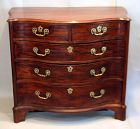
$11,500 Exceptional George III Serpentine Chest of Drawers or Commode in the French Manner having a moulded edge serpentine top with overhanging sides above two over three conforming drawers, rounded front corners and bold bracket feet. The drawer sides and bottoms are mahogany which is unusual since it was the most expensive wood during the 18th Century. Brass pulls may be original, escutcheons replaced.
English, Circa 1760.
Top: 42" wide
STUDIO ANTIQUES & FINE ART, INC.
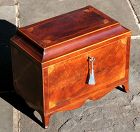
$11,500 Rare American Federal tea caddy in nicely figured mahogany with three sides and stepped lid inlaid with banding and corner fan decoration; rectangular, with shaped skirt and French bracket feet and divided interior. Probably 1800. Provenance: The Cockrell Collection.
See Montgomery, American Furniture, The Federal Period, #436-439 for other examples. Exhibited: “A Celebration of the Anniversary of the Boston Tea Party” at Doyles, Boston 2024 Height, 9.25”; Length, 12”; Width, 6.5.” Johannes Marinus Ten Kate (Dutch, 1859-1896)
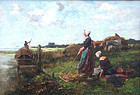
Working the Field Oil on canvas. signed lower right
Painting17" x 24 3/4" Ten Kate was known for his landscapes, beach scenes and genre paintings. Born in Amsterdam, he was the son of Johannes Mari ten Kate, under whom he most likely studied. He lived and worked in the Hague and was a member of the Hague Artists’ Society and the Pulchri Studio (latin:"for the study of beauty"), a Dutch art society, art institution and art studio based in the Hague. The countryside around the coastal town of the Hague provided a rural environment and an unspoiled landscape which attracted many young artists of the nineteenth century eager to escape the strictures of academic art guilds. William Richardson Tyler (American 1825-1896)
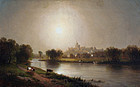
Misty Morning at Windsor Castle Oil-on-canvas, signed lower left
Painting Size: 18.5”” x 29.5” **Please Note: This item is not currently on view in our gallery. Please call at least 48 hours in advance if you wish to see it. Tyler is known to have lived and worked in Troy, NY during the 1850‘s and 60‘s where, aside from Abel Buell Moore, he was Troy’s best known artist. According to William Gerdts “Troy was a prosperous industrial and commercial city. It was also a major center of education in the 19th century. Tyler had gone to Troy to work for the carriage company of Eaton and Gilbert. In 1858 Tyler opened his own painting studio (and he) painted the local landscape but was more drawn to the sea. He specialized in scenes off the coast of Long Island and Massachusetts.” It is apparent from the record of his works that he traveled extensively in Europe painting scenes in Venice and scenes in England such as this luminist view of Windsor Castle. Tyler also painted the landscapes of the White Mountains (NH) and the Keene Valley in the Adirondacks of New York. Tyler exhibited at the National Academy of Design (1862-1867 and 1878) and his work “Breezy Day Off Boston Light” is held by the Troy Public Library. Sources: Richard Redgrave (British, 1804-1888)
Resting Deer in a Forest Landscape Oil on canvas Provenance: Thomas McLean Gallery, London (retaining the original label on the back).
Painting: 20.75" x 36" Redgrave was a genre and landscape painter. For a time he worked with his father who was an engraver before entering the Royal Academy in 1825. He began by painting historical genre in 18th century costume but in the 1840s he was among the first to depict contemporary social subjects in contemporary clothing (“The Seamstress”, “Bad News from the Sea”, “The Governess”). In 1836 he finally gained wider audience with his painting of “Gulliver on the Farmer’s Table”. Redgrave was involved with the organization of the Government School of Design (1847) as well as the first keeper of paintings at the South Kensington Museum (now known as the Victoria and Albert museum). He was Inspector of the Queen’s Pictures and co-author with his brother Samuel of “A Century of Painters of the English School”, still a valuable book on English art. Redgrave exhibited some 175 works at the Royal Academy from 1824-1883, the British Institution, the Society of British Artists and others. Several of his paintings are in the Victoria and Albert museum, the National Portrait Gallery (London) and the Shipley Art Gallery (Gateshead). Retiring from his many offices in 1880 due to ill health, Redgrave’s later work was mostly painted while summering at his country house, primarily landscapes painted in a pre-Raphaelite style.
Sources:
Architectural : Interior : Pre 1837 VR
item #1485882
(stock #RMT-585)
Rare English Regency Hawksbill and Greenback Tortoiseshell Tea Caddy with ivory and pewter stringing, having cut corners and a bowed front panel with pressed tortoise in concentric ovals with fan corners and central inlaid silver oval with leafage border; the bowed lid surmounted by a ball finial and the whole raised on ball feet. Circa 1800-15. (Key). Height, 6”; Length, 8”; Depth, 4.75.”
Exhibited: “A Celebration of the Anniversary of the Boston Tea Party” at Doyles, Boston 2024
Architectural : Interior : Pre 1837 VR
item #1485889
(stock #RMT-530)
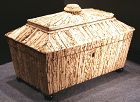
#530 Antique Anglo-Indian Tea Chest, sandalwood overlaid with strips of elk horn. The box is rectangular with sloped sides. The elk horn on the top of the stepped, sloping lid arranged in a starburst pattern. The fitted interior is decorated with incised ivory panels, highlighted with lac, a similarly decorated pair of removable caddies and a circular cut crystal sugar bowl and a horn caddy spoon. (The squashed ball feet are later replacements. Lid lack support).
Valtair, Vizagapatam, possibly by Chinniah, ca. 1840-50. See: Furniture from British India and Ceylon by Amin Jaffer, #61 for a similar workbox. Exhibited: The 48th Washington Antiques Show, “Inside and Outside the Box.” and “A Celebration of the Anniversary of the Boston Tea Party” at Doyles, Boston 2024
Height, 9”; Width, 14.75”; Depth, 8.5”.
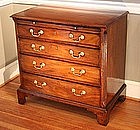
Exceptional George III bachelor’s chest in nicely figured mahogany with good color and patina, having a rectangular, cross banded top above an oak brushing slide and four graduated drawers flanked by canted, reeded corners and raised on straight bracket feet. English, circa 1780 (brasses replaced).
Length: 33.75” **Please note: This item is not currently on view in our gallery. If you would like to see it, please call at least 48 hours in advance.
Benson Bond Moore
(American 1882-1974)
"Summer on Chesapeake Bay, MD" Oil on canvas, signed lower right and titled on the reverse
Painting: 22" x 24" Provenance: The Estate of a Toms River Collector ** For other painting by artists from Maryland, Virginia or Washington DC, click on the "Regional Artists" button on our homepage Benson Bond Moore, painter, etcher and teacher was born in Washington, DC. He studied at the Corcoran School of Art with Messer and Brooke , and also with Weyl . He continued his studies in drawing at the Linthicum Institute under Ballenger and learned painting conservation from his father. Active in professional societies, he was a member and officer of the Landscape Club of Washington. He was also a longtime member of the Society of Washington Artists. He exhibited with both groups from as early as 1915 and continued through the 1930's. His work was also shown at the Corcoran Gallery of Art. As an artist, he became well known and honored for his local scenes, many of which are in major public collections. His works are held by the National Museum of American Art; Historical Society of Washington, DC; Library of Congress; The White House; Bibliothèque National de Paris; Cosmos Club; National Museum of American History; the Houston Museum of Fine Art and the Los Angeles Museum of Art. Over his life, he was honored with numerous awards for his work.
Sources: Benson Bond Moore
(American 1882-1974)
"Chesapeake Beach, MD" Oil on masonite, signed lower left and dated "1958" and titled on the reverse Painting: 20" x 24" Frame: 26" x 30" Provenance: The Estate of a Toms River Collector ** For other painting by artists from Maryland, Virginia or Washington DC, click on the "Regional Artists" button on our homepage Benson Bond Moore, painter, etcher and teacher was born in Washington, DC. He studied at the Corcoran School of Art with Messer and Brooke , and also with Max Weyl . He continued his studies in drawing at the Linthicum Institute under Ballenger and learned painting conservation from his father. Active in professional societies, he was a member and officer of the Landscape Club of Washington. He was also a longtime member of the Society of Washington Artists. He exhibited with both groups from as early as 1915 and continued through the 1930's. His work was also shown at the Corcoran Gallery of Art. As an artist, he became well known and honored for his local scenes, many of which are in major public collections. His works are held by the National Museum of American Art; Historical Society of Washington, DC; Library of Congress; The White House; Bibliothèque National de Paris; Cosmos Club; National Museum of American History; the Houston Museum of Fine Art and the Los Angeles Museum of Art. Over his life, he was honored with numerous awards for his work.
Sources:
Architectural : Interior : Pre 1800
item #1485883
(stock #RMT-573)
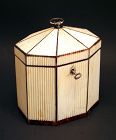
English octagonal ivory tea caddy with fluted ivory panels with tortoise shell stringing and banding, having a pyramidal lid with silver finial opening to a lidded compartment. Circa 1790. Height, 5”; Length, 4.25”; Depth, 3.25.”
Exhibited: “A Celebration of the Anniversary of the Boston Tea Party” at Doyles, Boston 2024 **Regarding the Sale of Items Incorporating Materials from Endangered Species: An export license issued by the U.S. Fish and Wildlife Service will be required for the export of this pre-CITES item from the U.S. Studio Antiques will not ship this item outside of the USA without proper paperwork, which is the buyer's responsibility.
Architectural : Interior : Pre 1900
item #1485885
(stock #RMT-637)
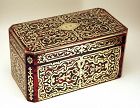
French Boulle Style Tea Caddy, rectangular with cut-corners and slightly domed lid with all sides and two interior lids extensively inlaid with engraved brass and red and black colored lacquer simulating tortoise-shell in the 17th century manner. Circa 1850.
Provenance: The Cockrell Collection. (Key). (See our #555 for a related example with blue lacquer ground.) See Clark & O’Kelly, p. 109-10 for related boxes. Height, 4.5”; Length, 8.75”; Depth, 4.5.” Exhibited: “A Celebration of the Anniversary of the Boston Tea Party” at Doyles, Boston 2024
Architectural : Interior : Pre 1837 VR
item #1485887
(stock #RMT-741)
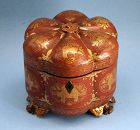
Rare Antique Chinese Export red lacquer melon-form tea caddy with six loebed sides, three gilt dragon paw feet, gilt decoration of figures in gardens on body and hinged lid with carved “stem,” opening to a similarly shaped tin liner. Circa 1825. Height, 5.5”; Diameter, 6.25” Gourds and mellons had a particular significance in Chinese culture.
See: ”Antique Boxes”by Clark and O’Kelly, figure #238 and our #620 for a similar example. Exhibited: “A Celebration of the Anniversary of the Boston Tea Party” at Doyles, Boston 2024
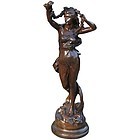
Jean-Baptiste Germain (French 1841-1910)
Primavera Bronze, signed. Height: 33” Known as a sculptor of classical and allegorical figures, Germain was a student of Dumont and Gumery. He worked with his brother Gustave in producing classical and historical statues and groups. Germain exhibited at the Paris Salon from 1866 to 1879 and later at the Salon des Artistes Français where he became an Associate in 1889. His bronzes include various images of Joan of Arc, Dido and Aeneas, The Harp Player, the Young Flutist and an Arab on his Camel.
Sources:
| |||||||||||