| Home | Shops | Join |
|
|
||
|
|
||||||
|
SUBCATEGORIES Featured Items (12)  Continental or colonial sculpted and painted wood Santos. Crystal eyes
 A strongly carved iron sukashi Kinai tsuba depicting a coiled dragon
Shops Active In This Category
MAIN CATEGORIES
|
STUDIO ANTIQUES & FINE ART, INC.
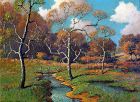
Now on View in Our Gallery Benson Bond Moore
(American 1882-1974)
"Stream in Autumn, near Bethesda MD." Oil on board, signed lower left and titled on the reverse
Painting: 12" x 16" SAFA/10945 Provenance: The Estate of a Toms River Collector Benson Bond Moore, painter, etcher and teacher was born in Washington, DC. He studied at the Corcoran School of Art with Messer and Brooke , and also with Weyl . He continued his studies in drawing at the Linthicum Institute under Ballenger and learned painting conservation from his father. Active in professional societies, he was a member and officer of the Landscape Club of Washington. He was also a longtime member of the Society of Washington Artists. He exhibited with both groups from as early as 1915 and continued through the 1930's. His work was also shown at the Corcoran Gallery of Art. As an artist, he became well known and honored for his local scenes, many of which are in major public collections. His works are held by the National Museum of American Art; Historical Society of Washington, DC; Library of Congress; The White House; Bibliothèque National de Paris; Cosmos Club; National Museum of American History; the Houston Museum of Fine Art and the Los Angeles Museum of Art. Over his life, he was honored with numerous awards for his work.
Sources: Benson Bond Moore (American,1882-1974)
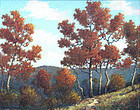
Autumn in the Blue Ridge Mountains (near Emmittsburg, PA[sic]) 1955 Oil on board, signed lower left and dated “1955”. Titled on the reverse
Painting Size: 15.5” x 19.5” ** For other painting by artists from Maryland, Virginia or Washington DC, click on the "Regional Artists" button on our homepage Benson Bond Moore, painter, etcher and teacher was born in Washington, DC. He studied at the Corcoran School of Art with Messer and Brooke , and also with Weyl . He continued his studies in drawing at the Linthicum Institute under Ballenger and learned painting conservation from his father. Active in professional societies, he was a member and officer of the Landscape Club of Washington. He was also a longtime member of the Society of Washington Artists. He exhibited with both groups from as early as 1915 and continued through the 1930's. His work was also shown at the Corcoran Gallery of Art. As an artist, he became well known and honored for his local scenes, many of which are in major public collections. His works are held by the National Museum of American Art; Historical Society of Washington, DC; Library of Congress; The White House; Bibliothèque National de Paris; Cosmos Club; National Museum of American History and the Los Angeles Museum of Art. Over his life, he was honored with numerous awards for his work.
Sources:
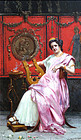
Consentino, Andrew and Glassie, Henry, The Capital Image, Painters in Washington, 1800-1915 Jose Rico y Cejudo (Spanish, 1864-1939)
Classical Figure with a Lyre Oil on Panel, signed and retaining a paper label on the reverse
Painting: 14.5" x 8.5" Jose Rico y Cejudo was born n Seville, Spain on March 27, 1864. He was the student of M. Ussel and J. Garcia Ramos at the School of Fine Arts in Seville. Eduardo Cano also played a role in the education of Cejudo as Cejudo would often pay visits to the artist'a studio. In 1888 he received a scholarship to study painting in Rome for seven years. While there, he made visits to the studios of his fellow countrymen Jose Villegas and Jose Gallegos. After his experiences in Rome, he returned to work in southern Spain. Cejudo taught art classes at the School of Fine Arts in Malaga from 1905. He exhibited his work and won various medals, such as a first place medal at Grenada in 1902, and a medal at the National Society of Fine Arts in 1910. Cejudo specialized in painting "anecdotal scenes from everyday life, often portraying his figures in gardens, patios and other intimate spaces. His paintings are characterized by a bright luminous palette." Some of his works are held in museum collections in Cadiz, Spain: London England and Madrid and Seville, Spain.
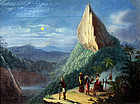
Sources: American School, Early 19th Century
Carib Indians Around a Jungle Campfire, with a Piton in the Background Oil on canvas, signed indistinctly on the stretcher. Mid 19th century carved wood, compo and gilt frame
Painting Size: 9.25” x 12”
Paintings : Watercolor : Pre 1900
item #908203
(stock #RMT-406)
English School (ca. 1850-1870)
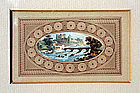
Two Antique English miniature watercolors with printed borders. Frame size: 7.5" x 8.5" James Francis O’Brien (American, 1917-1996)
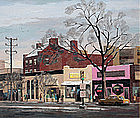
Bethesda Oil on canvas, signed lower left and titled on the reverse. Painting size: 20” x 24” Frame size: 25.5” x 29” ** Please Note - This painting came directly from the Estate of Mr. O’Brien. For other examples, type “O’Brien” into the search box. ** For other paintings by artists from Maryland, Virginia, Washington DC or North Carolina, click on the “Regional Artists” button on our Homepage. Born in Newtonville, Massachusetts, O’Brien exhibited a love of drawing and painting from a very early age. As a high school student, he took all possible elective courses in art and technical drawing. He supplemented this study with evening courses at M.I.T. Following his move to Washington, DC as a young man, he enrolled in the Washington Workshop of the Arts. WWA, like the Art Students League in New York City, was a school in which all the classes were taught by a rotating roster of professional artists. During WW II, his technical artistic training served his country well when he was put to work as a map maker. In the final year of the war, O’Brien married. On his honeymoon in New York City, he found time to paint the rooftop view from his hotel room window. This initiated a lifelong pursuit of city painting (his family was inclined to call it an obsession). Starting with the founding of Federal Graphics, a commercial art firm he launched with a partner in 1947, he pursued a commercial career for the majority of his life. However, he always considered painting his “real” work, and his dedication to this vocation was apparent in a myriad of ways. He helped to found the Montgomery County Art Association and held memberships in the Arts Council of Montgomery County and American Art League. Throughout his life, he exhibited widely, both as an individual and in group shows. The Arts Club of Washington, Corcoran Gallery of Art, Brooklyn Museum of Art, Montgomery College, and the Rehoboth Art League were a few among the many venues at which his works were shown. In addition, he exhibited in several private galleries. During the course of his painting, O’Brien noticed that the paints on his palette sometimes mixed into designs as interesting as those more deliberately created. From this observation arose the text, Design By Accident, first published in 1968. The book became widely used by art teachers following very favorably reviews by newspapers and magazines. It was even reviewed by Scientific American from a technological-aesthetic. A draftsman, illustrator, writer and most importantly painter, O’Brien was fortunate to have his work recognised and appreciated during his life. He won awards from The Montgomery County Art Association, Rehoboth Art League and American Art League. Even art critics praised his work with the most succinct calling his paintings, “familiar scenes, fresher and lighter than life”. (Florence Berryman of The Washington Star) O’Brien believed that the “creative urge” was something all children have. However, as adults, that impulse falls victim to ever growing demands and responsibilities. He maintained that artists are able to keep alive the childlike ability to see beauty and mystery in commonplace things. Thanks to his sense of wonder, he left us deeply in his debt. His paintings remind us that every day that Washington, DC is full of inspiring sights that fall outside of the traditional “glamour” views depicted by most artists.
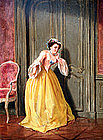
Eavesdropping
Oil on panel, signed and dated: “1865.”
Painting size: 9” x 6.75” Petrus Theodorus Van Wyngaerdt (also spelled Wyngaerdt or Wijngaerdt) was born in Rotterdam. A student of J.H. Van de Laar, he painted genre scenes and portraits, as did his older brother, painter Anthonie Jacobus Van Wyngaerdt. In "Eavesdropping", Van Wyngaerdt depicts a well-known theme from popular 19th-century French and Dutch prints-- a Roccoco figure listening at a door while a private conversation (or event) is underway. The women’s yellow skirt, pink bodice and lacy cap suggest that she is a lady (of sorts) and her plump arms, pretty features and sly expression suggest what may be going on behind closed doors. Van Wyngaerdt’s work can be found in the collections of the Haarlem Museum. He is listed in Dictionnaire des Peintres, Sculpteurs, Dessinateurs et Graveurs (Bénézit, 1999).
STUDIO ANTIQUES & FINE ART, INC.
On Hold Charles Francis Browne (American,1859-1920)
Clearing Fog Signed and dated: 1915
Ptg: 20"x 28" Born in Natick, Massachusetts, Charles Francis Browne was primarily active in Illinois as a landscape painter and teacher, and was one of the original members of the Eagle's Nest Art Colony in Oregon, Illinois. He was married to the sister of sculptor Lorado Taft. Browne played an active role in California in 1915 when he was the superintendent of the United States section of the Panama Pacific Exposition where he won an award for painting. He had traveled West previous to that time when, in the summer of 1895, he and sculptor Hermon Atkins MacNeil and writer Hamlin Garland took a tour of Indian reservation in Arizona and New Mexico. Their stops included the Navajo Reservation, the Hopis at Walpi and Zuni villages, and this trip provided Browne with much material for subsequent paintings. In 1910, Browne was Assistant Art Commissioner in South America to Buenos Aires and Santiago. He received his art training at the Museum of Fine Arts in Boston from 1882-84 and from Thomas Eakins at the Pennsylvania Academy of Fine Arts. In Paris, from 1887-90, he studied with Jean Leon Gerome at the Academie Julian. He became an instructor at the Art Institute of Chicago and shared a studio with George Schreiber. He was founder and editor of "Brush and Pencil" Club, president of the Chicago Society of Artists, and a member and director of the Western Society of Artists. At the Eagle's Nest Art Colony in Oregon, Illinois in the summer of 1919, he was stricken with paralysis. He died the following March at his mother's home in Waltham, Massachusetts. Sources:
Doris Dawdy, Artists of the American West Henry Perlee Parker (1795-1873)
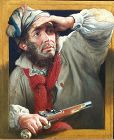
“On the qui vive” (The Smuggler) Oil on canvas , titled, signed and dated on the reverse "QUI VIVE" (A French phrase meaning long live who? (a sentry’s challenge), used to mean a state of alertness or watchfulness.)
Painting: 30" x 25" One of the best-known painters working in north-east England during the early nineteenth century Henry Perlee Parker specialized in pictures of marine subjects and smugglers and came to be known as "Smuggler" Parker. He was a leading artist in Newcastle in the 1820s and 1830s, a member of the Northumberland Institution, and a co-founder (with T.M. Richardson) of the ill-fated Northern Academy of Arts. He died penniless in Shepherd's Bush in 1873. There was an exhibition of his work at the Laing Art Gallery, 1969-1970. See Wiikpedia entry for a more complete biography Edmond Darch Lewis (American, 1835-1910)
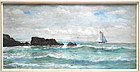
Schooner off the Atlantic Coast Watercolor on paper, signed lower left and dated “1896”
Sight Size:13" x 26" Lewis was born and died and Philadelphia where he studied with Paul Weber from about 1850-55. According to Peter Falk ("Who Was Who in American Art"), “he was one of the most popular landscape painters of Philadelphia during the late 19th century. His early works were chiefly scenes of the Lehigh, Susquehana, and Wissihickon Rivers of Pennsylvania, and were in great demand. Before 1860 he also exhibited landscapes of New York and New England and even some Cuban scenes. By the mid 1870’s he turned increasingly to shoreline views with yachting scenes, painting prolifically in watercolor from Cape May, NJ to Narragansett, RI. Wealthy and admired, he entertained in a grand style in his opulent Philadelphia home surrounded by an extensive collection of antique furniture, china and decorative arts.”
STUDIO ANTIQUES & FINE ART, INC.
This item has been sold. It remains on our website for internet research purposes.
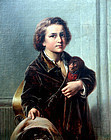
August Carl Vilhelm Thomsen (Danish 1813-1886)
Young Busker With His Monkey Oil-on-canvas, signed lower right
Painting Size: 24.5” x 20” Thomsen was an artist adept at painting many different subjects: landscapes, portraits, genre scenes, mythological subjects and religious scenes. He was a student at l’Académie des Beaux-Arts in Copenhagen. He painted numerous altar pieces for the churches of Copenhagen as well as the country churches of surrounding area. This sensitive painting depicts a young street musician with his hurdy-gurdy slung over his back, his monkey tucked under his arm and his outstretched hand with his hat ready to receive coins.
Source:
STUDIO ANTIQUES & FINE ART, INC.
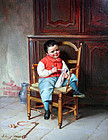
This item has been sold. It remains on our website for internet research purposes. Mrs. J. Lizzie Cloud (British, flourished 1873-1880)
Young Boy With Doll and Clay Pipe Oil on board, signed lower left and dated "1872"
Painting Size: 10.5” x 8.25” Mrs. Cloud was a painter of domestic genre scenes and is recorded as having exhibited at the Royal Academy, Suffolk Street and other galleries in England. A title of one of her paintings was “The Connemara Postman”. Little seems to be known of her painting career, but she wrote several articles for “Harper’s New Monthly Magazine” (Harper & Brothers, NY) which are all about her travels as a single woman in the 1870’s and 80‘s in Ireland. Her charming pen drawings illustrate rural life and scenes in Ireland for each article. Titles include: “A Lone Woman in Ireland”(1873), "The Connemara Hills" (1879), “An Irish Fishing Village” (1880) and “Ireland - The Arran Islands” (1881)
Sources:
Paintings : Pre 1837 VR
item #1215877
(stock #10382)
STUDIO ANTIQUES & FINE ART, INC.
This item has been sold. It remains on our website for internet research purposes. Frederick Calvert (British 1785-1845)
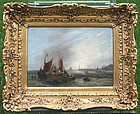
Squally Day off the Coast with Lighthouse and Unloading the Fishing Boats Oils-on-canvas, one signed lower left
Painting Size: 10"� x 14" Born in Cork, Calvert first exhibited at the Dublin Society of Artists and the Hibernian Society in 1815. Upon moving to London in the 1820's, Calvert was became known as a painter of shipping and coastal scenes as well as a topographical watercolorist and engraver. Calvert exhibited at the British Institution and Society of British Artists from 1827-1844. In 1830 he published "Picturesque Views of Staffordshire and Shropshire", and he also worked for the "Archaeological Journal". His works are held by the Victoria and Albert Museum, the National Maritime Museum (Greenwich), and the Walker Art Gallery (Liverpool).
Sources:
Paintings : Pre 1920
item #1189391
(stock #8470)
William F. Walter (American, 1904-1977)
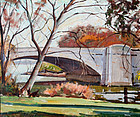
Bridge in Washington Oil on canvas, signed. Painting size: 20” x 24” Frame size: 27.75” x 31.5” A Washington, DC native, Walter was a respected designer, cartoonist, teacher and painter during his lifetime. After completing his studies at the Corcoran School of Art, he continued his training under the instruction of Charles Hawthorne, W. Lester Stevens, Richard Meryman and B. Baker. Walter was member of the Society of Washington Artists; Landscape Club, Washington, DC; Washington Art Club; American Polar Society and Southern States Art League. His work was shown in numerous venues including: Harvard University, University of Iowa, Washington Art Club and various museum in the East and South. He also held a solo exhibit in New York City. He was awarded prizes for his work by the Landscape Club and US National Museum. In addition to his busy painting and exhibition schedule, he completed a series of Arctic paintings for the Navy in 1946 and taught at the Abbott School of Art in Washington, DC from 1951-1954. ** For other artwork by artists from Maryland, Virginia or Washington DC, type “local” into the search box.
Paintings : Pre 1920
item #1188277
(stock #10310)
STUDIO ANTIQUES & FINE ART, INC.
This item has been sold. It remains on our website for internet research purposes. Ruth Killick Morley (American, b.1888)
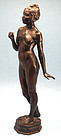
Standing Nude A Bronze Figure, signed Height: 16.5” Born in England in 1888, Morley settled in New York and was a sculptor, craftsperson and teacher. She was a member of the Allied Artists of America and exhibited at the Pennsylvania Academy of Fine Arts. She is listed in Falk, Who Was Who in American Art.
Paintings : Watercolor : Pre 1920
item #1186202
(stock #8443)
STUDIO ANTIQUES & FINE ART, INC.
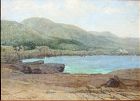
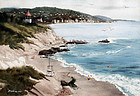
On Hold View of Laguna Beach
Charles Ross Kinghan (American, 1895-1984) Watercolor on paper, signed. A painter and illustrator, Kinghan trained at the American Academy of Art and the Art Institute of Chicago. In addition to his studio work, Kinghan began a career as an art teacher. In 1937, he first offered private instruction. While that continued throughout his life, he also worked for a time at the American Art Academy which was followed by a position at the Huguenot School of Art. After leaving art academia, Kinghan worked for over ten years for various advertising agencies as a “sketch man”. While busily employed in various capacities during his life, Kinghan also found time to participate in many exhibitions. His work was shown at the Art Institute of Chicago, Allied Artists of America, American Watercolor Society, National Academy of Design and many others. In addition to winning two gold medals from the Allied Artists of America, in 1956 and 1964, Kinghan was a member of the association. He also held memberships in The National Academy, Academy Artists Association, American Watercolor Society and Hudson Valley Art Association. He served both the American Watercolor Society and Hudson Valley Art Association as vice president in 1969 and 1968, respectively. He was a resident of Laguna Beach, CA at the time of his death. Kinghan is listed in Who Was Who in American Art by Falk.
Sight size: 14.5” x 20.5”
Paintings : Pre 1910
item #756305
(stock #9705)
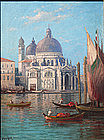
Chiesa Santa Maria Della Salute
Oil on canvas, signed lower left and entitled on reverse.
American painter C. Myron Clark specialized in marine subjects and, like so many other artists, was drawn to Venice with its ongoing atmospheric shifts in the sky and sea. This work shows the church of Santa Maria della Salute, one of the city’s landmarks, at the end of the day. Clark captures the effects of the mellowing light which emphasizes the architectural details of the Baroque church and gives the surrounding buildings a soft, rosy glow. The dappled reflection of the buildings in the water animate the painting’s surface, creating a sense of energy as gondoliers navigate their small boats along the Grand Canal.
Paintings : Pre 1920
item #694042
(stock #8803)
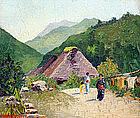
Helen Wells Seymour
(American, 19th/20th century) Japanese Landscape with Figures Oil on canvas board, signed.
Painting size: 12” x 14”
"Helen Wells Seymour (1878-1937) was educated in the Friends School in Washington, D. C. and she took special courses for two years in Columbia University and in the Doshisha Women's College, Kyoto, Japan. She spent several years of her life in Japan and China, was a collector of textiles and Japanese wall paintings, received diplomas in several Japanese arts, on which she lectured as a voluntary service, in the Women's College, Kyoto. She was a member of the Society of Women Geographers, of the Japan Society, the Society for Japanese Studies, and the Washington Club. She was a gifted painter of Japanese subjects and exhibited her work both in Japan and the United States. She left a rare and valuable collection of textiles, both Japanese and Chinese, and some fine wall paintings." Seymour exhibited at the Society of Independent Artists in 1918. She also had an affiliation with the Pennsylvania Academy of Fine Arts as reported in Mallett, "Index of Artists Supplement", which also identified her as having a Washington, DC address. Seymour is listed in Falk, "Who Was Who in American Art" and Marlor, "The Society of Independent Artists".
| |||||||||||