| Home | Shops | Join |
|
|
||
|
|
||||||
|
SUBCATEGORIES Featured Items (12)  Set Five Ko-Imari Kakiemon Style Polychrome Enamel Cups
 Southern Mid-Atlantic or Tidewater region walnut Chippendale chair
Shops Active In This Category
Spoils of Time (7)
MAIN CATEGORIES
|
Architectural : Interior : Pre 1800
item #1364321
(stock #10865)
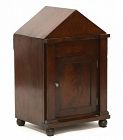
Rare George III Ambry in mahogany having an hinged arched top opening to a well and a paneled cabinet door flanked py pilasters, and the whole raised on ball feet. In Christian churches, items kept in an ambry include chalices and other vessels, as well as items for the reserved sacrament, the consecrated elements from the Eucharist.
English, circa 1760.
18" x 14" x 28" tall
Alethea Hill Platt
(American, 1861-1932)
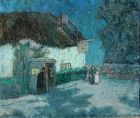
Devonshire Cottage by Moonlight Oil-on-canvas, signed lower left
Painting: 25” x 30” Platt was active in New York State and Connecticut. She is known for her landscapes, portraits and interiors. She studied at the Art Students’ League (NYC) and Delecluse Academy, Paris. Platt also studied with Ben Foster and Henry B. Snell. She exhibited at the Pennsylvania Academy of Fine Art (1900-1901), Boston Art Club, Society of Independent Artists (1917) and many others. Additionally she was a member of the New York Woman’s Art Club, Pen & Brush Club, National Arts Club and the New York Water Color Club. Platt travelled to Europe, painting scenes both in Devon and Normandy, often depicting charming interiors showing the life of the peasants.
Architectural : Decorations : Pre 1800
item #1358914
(stock #10843)
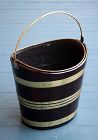
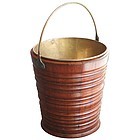
Fine George III Oval Brass Bound Peat Bucket with mahogany staves and brass banding, liner and loop handle.
English, Circa 1780.
13" x 10" x 12.5" (not including handle)
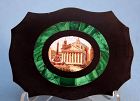
Exceptional Grand Tour Micro-mosaic plaque with an extremely fine oval micro-mosaic image of the Pantheon in Rome: on a cartouche shaped black marble ground, with an oval malachite surround.
Italian circa 1860.
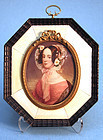
4" x 3" Oval portrait miniature of a young woman; watercolor, signed indistinctly. She is wearing a lace and floral trimmed bonnet, braids coiled over her ears, pearls and a ruched off the shoulder rose dress, all typical of the 1840’s.
Frame: 5.5” x 4.75”
Prints : Engravings : Pre 1900
item #1347731
(stock #9174)
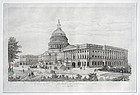
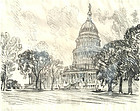
View of the Capitol at Washington in 1892
Studio Antiques has found the original engraved copper printing plate of the “Capitol at Washington” done by Max Franke in 1892. We are offering a limited edition re-strike engraving of this print, handpulled from the original plate by master printmaker Roger Bailey. It will be limited to a numbered edition of only 350 and will not be republished. Each print comes with a “Certificate of Authenticity” Lost for over a century, the unidentified copper printing plate was found at a small Washington D.C. area auction. It was dark, tarnished and dirty but we were able make out the figure of Freedom on the dome of the Capitol Building. We bought it, not knowing if it could ever again be used to print an image. We met with Professor Roger Bailey who taught printmaking at Sara Lawrence College. He suggested trying to pull a print and over the next several months he was able to meticulously restore the plate to good condition without over-restoring it to the point that it looked new. The resulting print is a stunning genuine intaglio image of our nations Capitol in 1892. These fine quality re-strikes are not to be confused with the normal type of “fine art” prints that are widely available from many galleries or poster stores, which are generally photo lithographs of varying quality and printed on a modern paper, often not of archival quality. The subtle look and feel of a genuine intaglio art print, on fine paper along with its plate mark just cannot be reproduced with modern methods. Each impression is crafted individually and entirely by hand, in the same manner as the copperplate printer of centuries ago.The traditional hand pulled method of printing and archival quality of the paper ensures these will far outlast normal “fine art” prints.
Plate Size: 12” x 17.75”
Lucien Whiting Powell
(American 1846-1930)
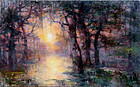
Bayou Oil-on-canvas, signed lower left Provenance: Senator John B. Henderson (1826-1913)
Painting: 23” x 37” Born 1846 in Upperville, Lucien Whiting Powell served with the Virginia cavalry during the Civil War. After attending the Pennsylvania Academy of Fine Arts, Powell moved on to the London School of Art by 1875 where he was strongly influenced by the atmospheric painting style and romantic subject matter of J.M.W. Turner. Powell eventually settled in Washington D.C. where he had a series of different studios, the most noted one at Henderson’s “Castle” on 16th Street owned by his formidable patron, Mrs. John B. Henderson. Perhaps with a certain proprietary attitude towards the artist, Mrs. Henderson owned some 200 of his watercolors and works on canvas and funded his tour of the Middle East in 1910. An avid traveler, Powell also toured the American West in 1901. His best known works are landscapes of the Grand Canyon as well as land- and seascapes of Venice. In Street Scene in Florence, Italy, a casual gathering of women proffer goods under cloth and wooden awnings in an open square. Powell’s warm, earthy palate and loose, painterly rendering reflect his admiration of Turner. Though he ventured far afield, Powell achieved considerable recognition in the District; his works were collected by Franklin Delano Roosevelt and Mrs. Woodrow Wilson. He also exhibited regularly at the Corcoran and was a member of the Society of Washington Artists. Powell’s work is currently represented in the collections of American University, Georgetown University, the U.S. State Department and the Historical Society of Washington, D.C Sources:
Falk, Peter, ed. Who Was Who in American Art 1564-1975 ** For other paintings by artists from Maryland, Virginia, Washington DC or North Carolina, click on the “Regional Artists” button on our Homepage.
Max Weyl (German/American, 1837-1914)
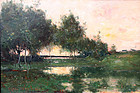
"Evening on the Marsh" Oil on Academy Board, signed and dated "(18)88", dated "Dec. 27,1888" on the reverse and titled by Benson B. Moore also on the reverse. Provenance: The Washington area painter Benson B. Moore. Moore studied with Weyl at the Corcoran in Washington D.C.
Painting: 11 x 16 in. **Please Note: This item is not currently on view in our gallery. Please call at least 48 hours in advance if you wish to see it. ** For other paintings by artists from Maryland, Virginia, Washington DC or North Carolina, click on the “Regional Artists” button on our Homepage. Max Weyl was born Dec. 1, 1837, in Germany and immigrated with his family to Williamsport, PA in 1853. At this time and after his arrival in Washington, DC in 1861, Weyl earned his living as an itinerant watch repairman. At the relatively young age of 24, he had saved enough money to open his own jewelry shop at Third Street and Pennsylvania Avenue. He was self-taught as an artist but was encouraged in the field by Washington artist Charles Lanman, who recognized his potential artistic talent. In 1870, Weyl sold his first painting to Samuel H. Kauffman, publisher of the Star . Kauffman became a regular patron of Weyl. By 1878, he had achieved sufficient success to list himself as an artist in the city directory and had devoted himself full-time to his art. A year abroad in 1879-80, visiting and studying in Paris, Vienna, Munich and Venice attached him to the Barbizon style and gave him his nickname of the "American Daubigny". His first exhibition and sale of landscapes was in 1879. Eventually, his landscapes of the Potomac River and Rock Creek Park won him much recognition and acclaim. During the years of 1882-92, he shared a studio with Richard Norris Brooke in Vernon Row at 10th and Pennsylvania, moving to the "Barbizon Studio" building, on 17th and Pennsylvania, from 1892-1903. Weyl had annual exhibitions and sales at V.G. Fischer Galleries. There was a retrospective at the Corcoran Gallery of Art in 1907. Weyl died July 6, 1914, in Washington, DC. Today his work can be seen in such varied locations of the Corcoran Gallery, the Cosmos Club in Washington, the National Trust for Historic Preservation and Virginia Military Academy.
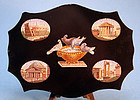
Sources: ** For other paintings by artists from Maryland, Virginia or Washington DC, type “local” into the search box. Cartouche-shaped black marble plaque inset with oval micromosaic panels depicting Roman archaeological scenes (clockwise from upper left): the Coliseum, the Temple of Hercules, the Roman Forum and the Pantheon. Those four panels surround the Doves of Pliny, an image often used in micromosaics, which comes from a Roman floor mosaic at Hadrian’s villa in Tivoli and is believed to be a copy of a lost ancient Greek mosaic at Pergamon described by Pliny the elder.
Such items were collected by visitors to Italy on the Grand Tour as they were easily portable. Micromosaics began to be made in Italy during the Renaissance and reached the height of their popularity in the mid nineteenth century. This example was made from the smallest pieces of glass (tesserae), a technique developed in the 18th century in the Vatican Mosaic Workshop. The edge of the plaque is incised and and would have originally been wrapped with a braided gilt-metal rope, tied at the top for hanging. Circa 1850-1875 5 ¼” x 4” Source: The Victoria and Albert Museum, the Gilbert Collection (Minor chips to the edges.)
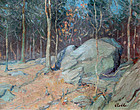
August H. O. Rolle
(American 1875-1941)
Rock Creek Park Oil-on-canvas, signed lower left.
Painting: 16” x 20”
August Herman Olson Rolle, painter, printmaker and graphic artist, dabbled in many activities before turning his focus to art. Born in Sibley County, MN, in 1875, his first path toward adulthood led him to Red Wing Seminary. Service in the Spanish-American War, eventually lead him to Washington, DC where he became a forestry expert for the Census Bureau.
Sources: ** For other paintings by artists from Maryland, Virginia, Washington DC or North Carolina, click on the “Regional Artists” button on our Homepage.
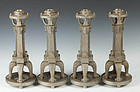
Set of Four Hammered and Silvered Bronze Arts and Crafts Candlesticks, Early 20th Century, Unmarked. 13" high.
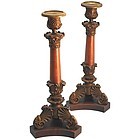
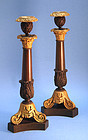
FinePair of Italian Grand Tour Bronze Candlesticks with nicely detailed foliate decoration and with good patina and fine castings. Having a removable ormolu drip pan above a bronze candle cup and supported by a turned and foliate decorated column with a tripartite scrolling ormolu base and mounted on a tripartite bronze plinth. These would have been brought home as a souvenir by someone who had made the Grand Tour. Italy, circa 1870.
Height: 11.25"
Antique Dutch Turned Mahogany Peat Bucket having tapering staved sides with molded and ring turnings and with brass liner and carrying handle. Holland, circa 1820
Height to Rim: 12.5"
Diameter: 12.5"
Prints : Lithographs : Pre 1920
item #1333369
(stock #10717)
Joseph Pennell
(American 1857-1926)
The Inauguration Steps, 1912 Lithograph on ivory laid paper 17 x 22 (image); 19 x 24.5 (sheet); 17.75" x 22.25" (sight); 24" x 30" (frame) Wuerth 265 Washington D.C. series. Edition of 25. Signed on stone and in pencil and inscribed: " #2 The Inauguration Portico" This is from a series of six lithographs made for the Century Magazine entitled "The Capitol at Washington” and described as the "East Front of the Capitol" Another example is in the collection of the Art Institute of Chicago. Joseph Pennell was widely recognized for his illustrations and etchings, a process he began in the late 1870s. The son of Philadelphia Quaker parents, he studied at the Pennsylvania Academy of Fine Art in Philadelphia where his instructor, James Claghorn recognized and encouraged Pennell's etching talent. From 1884 to 1917, Pennell lived primarily in Europe. There he made scenery prints in many parts of the Continent, working in a variety of graphic media. He also returned to America long enough to travel in the American West, and in 1912 and 1915, did scenes of San Francisco, Yosemite and the Grand Canyon, which along with twenty-three lithographs he did of the Panama Canal were purchased by the Italian government and are in the Uffizi Gallery. Pennell completed over 1800 etchings and lithographs. His style was strongly influenced by James Whistler, and his technique was influenced by drawings of Charles Reinhardt. He also wrote and illustrated nearly a hundred books including a biography of Whistler.
Sources: Exceptional Pair of Italian Bronze and Ormolu Candlesticks with nicely detailed foliate decoration and with good patina and fine castings. Having a removable ormolu drip pan above a bronze candle cup and supported by a turned and foliate decorated column with a tripartite scrolling ormolu base and mounted on a tripartite bronze plinth. These would have been brought home as a souvenir by someone who had made the Grand Tour. Italy, circa 1870.
5" x 5" x 13"tall
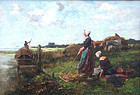
Johannes Marinus Ten Kate (Dutch, 1859-1896)
Working the Field Oil on canvas. signed lower right
Painting17" x 24 3/4" Ten Kate was known for his landscapes, beach scenes and genre paintings. Born in Amsterdam, he was the son of Johannes Mari ten Kate, under whom he most likely studied. He lived and worked in the Hague and was a member of the Hague Artists’ Society and the Pulchri Studio (latin:"for the study of beauty"), a Dutch art society, art institution and art studio based in the Hague. The countryside around the coastal town of the Hague provided a rural environment and an unspoiled landscape which attracted many young artists of the nineteenth century eager to escape the strictures of academic art guilds.
STUDIO ANTIQUES & FINE ART, INC.
$35,000 Harriette F A Sutcliffe (British, fl.1881 - 1922)
Beauty and the Beast Oil on canvas, signed with monogram and titled on the reverse Exhibited: The Royal Academy, 1899 Miss Suitcliff was a Hampstead painter of genre and portraits who exhibited at the royal academy from 1881-1899 and elsewhere. Source: Christopher Wood, The Dictionary of Victorian Painters Painting Size: 16" x 20" Frame Size: 24" x 28"
Spoils of Time
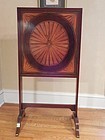
$4,400.00 An unusual and dramatic firescreen abattant. It reminds me of some of the smaller, New York classical parlor furniture I've seen in Southern house tours with late Federal drawing and music rooms furnished with pieces imported by successful merchants - almost, but not quite, over the top in their design yet direct in their function. So an argument could be made for high, New York city style. And the inlaid oval in the center, with pie crimped edge, is reminiscent of some New England work. The passive function is that of a firescreen and explains the distress to the side with inlay which likely faced the fireplace (rather than the upholstered side.) The "surprise" is the enclosed work area with the hinged top dropping to provide a writing surface (abattant [fr], "put horizontal") below the interior fitted with letter or document slots (only the back one of three dividing slats remaining - evidence of two more, and three segments which would have divided at least one of two lateral slots into three sections.) Perhaps because of the narrow profile, there appears to be no secondary wood under or behind any of the solid mahogany. Condition is quite good considering the likely heat exposure as a firescreen and probable stress to the hinged top which relies upon the case as a counter-stop. We had distress to the inlaid surface evened out, filled and finished - disturbing old finish as less as possible - to make it presentable for the decorator yet acceptable to the collector. We left the old upholstery (possibly original) alone for the next steward to decide. Our restorer (specializing in period furniture) had also never before encountered this design. Our photographs illustrate the character of the old, now serviceable inlaid surface. Ca 1800 - 1810. Height, about 42 3/4 inches. Width, about 21 5/8 inches (about 22 1/4 inches wide at the trestle base).
This firescreen abattant may be inspected at The Antique Center at Historic Savage Mill, Maryland
| |||||||||||