| Home | Shops | Join |
|
|
||
|
|
||||||
|
SUBCATEGORIES Featured Items (12)  Massive 17th, 18th Century Ko-Imari Bijin Vase, Probably Genroku Era
 American Federal Mohagany Inlaid Firescreen with Hinged Work Surface
Shops Active In This Category
Spoils of Time (7)
MAIN CATEGORIES
|
Architectural : Interior : Pre 1800
item #1317829
(stock #10520)
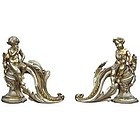
Exceptional pair of antique French Gilt Bronze Fireplace Chenet in the form of Dionysian children seated on a plinth and eating grapes, and with foliate and cyma curved decoration. 18th/19th Century.
Each Approx.: 12.5" x 12.5" x 5.5 deep
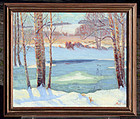
August H.O. Rolle (American 1875-1941)
River Birches Oil on Canvas, Signed lower right and titled and signed on reverse
Painting: 20" x 24" ** For other paintings by artists from Maryland, Virginia, Washington DC or North Carolina, click on the “Regional Artists” button on our Homepage. August Herman Olson Rolle, painter, printmaker and graphic artist, dabbled in many activities before turning his focus to art. Born in Sibley County, MN, in 1875, his first path toward adulthood led him to Red Wing Seminary. Service in the Spanish-American War, eventually lead him to Washington, DC where he became a forestry expert for the Census Bureau. Once in Washington, Rolle studied at the Corcoran School of Art under Messer, Brooke and Moser beginning in 1905. His specialties were landscapes and seascapes in oil and watercolor, but he also executed dryprints, woodblock prints, monotypes and etchings. Following the tradition of his day, Rolle was active in many art societies. In addition to helping found the Landscape Club of Washington in 1915, he served as its president for many years. That was just one among a number of affiliations which also included the Sculptors and Gravers Society of Washington, the American Federation of Arts, and the Arts Club of Washington. Rolle also exhibited at the Corcoran Gallery of Art, the old National Gallery, the Maryland Institute and at the Greater Washington Independent Exhibition of 1935. He had a joint exhibition of prints with fellow artist Benson B. Moore at Venable's Gallery in 1924. Rolle died in Washington, DC in 1941. Today, his work is represented at the Corcoran Gallery, the Historical Society of Washington, DC, and the Arts Club of Washington. A retrospective of his work was held at the Corcoran's 1982 "Washington on the Potomac" and at the National Museum of American Art's 1984 show "The Capitol Image."
Sources: Richard Redgrave (British, 1804-1888)
Resting Deer in a Forest Landscape Oil on canvas Provenance: Thomas McLean Gallery, London (retaining the original label on the back).
Painting: 20.75" x 36" Redgrave was a genre and landscape painter. For a time he worked with his father who was an engraver before entering the Royal Academy in 1825. He began by painting historical genre in 18th century costume but in the 1840s he was among the first to depict contemporary social subjects in contemporary clothing (“The Seamstress”, “Bad News from the Sea”, “The Governess”). In 1836 he finally gained wider audience with his painting of “Gulliver on the Farmer’s Table”. Redgrave was involved with the organization of the Government School of Design (1847) as well as the first keeper of paintings at the South Kensington Museum (now known as the Victoria and Albert museum). He was Inspector of the Queen’s Pictures and co-author with his brother Samuel of “A Century of Painters of the English School”, still a valuable book on English art. Redgrave exhibited some 175 works at the Royal Academy from 1824-1883, the British Institution, the Society of British Artists and others. Several of his paintings are in the Victoria and Albert museum, the National Portrait Gallery (London) and the Shipley Art Gallery (Gateshead). Retiring from his many offices in 1880 due to ill health, Redgrave’s later work was mostly painted while summering at his country house, primarily landscapes painted in a pre-Raphaelite style.
Sources:
Prints : Pre 1920
item #1302113
(stock #10663)
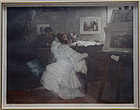
Manuel Robbe (French, 1872-1936)
Nocturne (ou Le Flirt) Aquatint with etching in colors, circa 1906, on wove paper, signed in pencil in the image lower left. From the edition of about 100, with minor staining in the margins, not examined out of the frame.
Image Size: 13.5" x 17.5" Robbe was a painter of genre scenes, a watercolorist, pastellist, engraver, designer and illustrator. He studied both at the Académie Julian and the École des Beaux Arts in Paris where he was mentored in etching and aquatint methods by Eugene Delâtre. He exhibited in Paris regularly at the Salon des Artistes Français and was awarded a bronze medal in 1900 at the Exposition Universelle in Paris. Leaving that salon in 1905, Robbe became a member of the Salon de la Société Nationale des Beaux-Arts. He chiefly worked in the medium of colored aquatint engravings in which he had become quite accomplished. He was an innovator of the experimental “à la poupée” process of printing many colors from a single plate which gave his prints a startling subtlety, each print having its own uniqueness. Robbe’s favorite themes were of scenes of Paris life, scenes of streets animated by young parisiennes of the Belle Époque and young women and children engaging in the social activities of the day. His prints were designed to be framed and hung on the wall just like oil paintings.
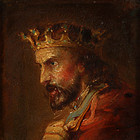
Source: *Manuel Robbe's works are catalogued and described by a series of soft covered books published by Merrill Chase Galleries in 1978, 1979, and 1980. These books serve as the recognized catalogue raisonné for Robbe. Peter Paul Duggan (Irish/American 1810 ? -1861)
Macbeth Oil on artist board Provenance: Sycamore Farm, Portsmouth, VA (Estate of Robert Vick and Charles Sibley) Note: Listed in "The National Academy of Design Exhibition Record 1861-1900" page 249, number 482.
Painting Size: 6 ½” x 6 ½” Born in Ireland, Duggan was brought to the United States as a young child, probably around 1810. He was a student at the National Academy of Design from approximately 1842-1849. He was a frequent exhibitor at the National Academy as well as at the Pennsylvania Academy of Fine Art. Duggan was known to have exhibited works at the Academy (1844-51) which were religious and historical in nature although he was admired by his contemporaries as a portraitist in charcoal and crayon - undoubtedly the source of his livelihood. Later works exhibited (1855-56) were portraits only. He also sculpted several medals for distribution by the American Art-Union. In the late 1840’s Duggan was a professor of drawing at the Free Academy of New York (later the City College of New York). Duggan suffered from tuberculosis and retired in 1856 at which time he went to live in London with relatives. In the spring of 1861 he went to Paris for what was intended to be an extended stay but was there only until October when he succumbed to his illness.
Sources: John Henry Smith (British, fl.1852-1893)
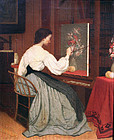
An Artist at Work Oil-on-canvas, signed lower left and dated “1863”
Painting Size: 22.25” x 18” This charming portrait of a young woman artist at work is a wonderful depiction of the painter and her tools. Her subject of a vase of flowers with fruit sits on a table to her right. The sturdy adjustable easel has a shelf where she has laid out her tubes of pigments. She is using a mahl stick to create a bridge across the canvas which supports her painting hand to avoid touching the surface. An artist’s apron lays across her lap to protect her skirt. Her full concentration is on the canvas in front of her which is nearing completion. J. Henry Smith was a painter of genre, landscapes and animals, living in London, Brixton and South Lambeth who exhibited extensively from 1852-1893 at the royal Academy, the British Institution, the society of British Artists and elsewhere. Titles exhibited at the Royal Academy included “Where the Shoe Pinches” (1882) and “A Book is the Best Solitary Companion in the World” (1885).
Sources:
Paintings : Pre 1900
item #1256263
(stock #10560)
Ebenezer Colls (British , 1812-1887)
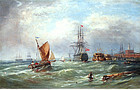
"The Old Ship Victory off Southampton Water" Signed lower left and titled on an old label on the reverse.
Painting: 26" x 17.25" Colls was a painter of shipping and coastal scenes who lived in Camden Town, London and exhibited at the British Institution from 1852-4. The National Maritime Museum in Greenwich has a pair of his paintings. Denys Brook-Hart (see below) comments "Ebenezer Colls' pictures are quite rare although some paintings which are not his are sometimes attributed to him." HMS Victory is a 104-gun first-rate ship of the line of the Royal Navy, laid down in 1759 and launched in 1765. She is most famous as Lord Nelson's flagship at the Battle of Trafalgar in 1805. After 1824 she served as a harbor ship. In 1922 she was moved to a dry dock at Portsmouth, England, and preserved as a museum ship.
Sources:
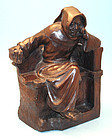
Antique Carved Oak Statue of a Monk holding a book and seated on a curved bench. Probably American, circa 1880.
9" x 9" x 14" tall
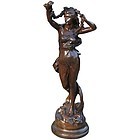
Jean-Baptiste Germain (French 1841-1910)
Primavera Bronze, signed. Height: 33” Known as a sculptor of classical and allegorical figures, Germain was a student of Dumont and Gumery. He worked with his brother Gustave in producing classical and historical statues and groups. Germain exhibited at the Paris Salon from 1866 to 1879 and later at the Salon des Artistes Français where he became an Associate in 1889. His bronzes include various images of Joan of Arc, Dido and Aeneas, The Harp Player, the Young Flutist and an Arab on his Camel.
Sources:
Paintings : Watercolor : Pre 1900
item #1216942
(stock #7656)
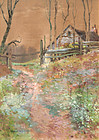
A By-path
Henry Hobart Nichols, Jr. (American, 1869-1962) Watercolor on paper, signed and dated: “1897”. Exhibited at the Third Annual Washington Water Color Club, 1898. Illustrated in McMahan, The Artists of Washington, DC: 1796-1996, p. 158. Provenance: from the Estate of Virgil McMahan. A painter and illustrator, Nichols was a member of quite an artistic family. His father, brother and wife were all professional painters as well. He had diverse training beginning with instruction from Howard Helmick. He also attended the Art Students League of Washington before heading to Europe. In Europe, he studied at both the Froebel Institute in Germany and at the Academie Julian in France. His early career (1889-1905) included a position on the Board of the Art Students League, as well as employ by the U.S. government. He worked as an illustrator for both the U.S. Geological Society and the Bureau of American Ethnology. A member of the Washington Watercolor Club and Society of Washington Artists, Nichols favored subject was landscapes. Nichols is listed in Who Was Who in American Art by Falk.
Sight size: 13” x 9.5” ** For other paintings by artists from Maryland, Virginia or Washington DC, type “local” into the search box.
Architectural : Decorations : Pre 1900
item #1216773
(stock #10360)
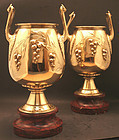
Fine Pair of French Brass Urns with two handles, raised relief of floral
sprays on the sides, and with rouge marble bases.
Late 19th century.
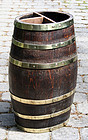
Height: 12” Antique English Umbrella or Stick Stand of Coopered construction, oval, with brass binding with oak staves. Now fitted with a divided top and interior tin drip tray. 18th/19th Century.
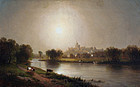
16" x 13" x 24.5" tall William Richardson Tyler (American 1825-1896)
Misty Morning at Windsor Castle Oil-on-canvas, signed lower left
Painting Size: 18.5”” x 29.5” **Please Note: This item is not currently on view in our gallery. Please call at least 48 hours in advance if you wish to see it. Tyler is known to have lived and worked in Troy, NY during the 1850‘s and 60‘s where, aside from Abel Buell Moore, he was Troy’s best known artist. According to William Gerdts “Troy was a prosperous industrial and commercial city. It was also a major center of education in the 19th century. Tyler had gone to Troy to work for the carriage company of Eaton and Gilbert. In 1858 Tyler opened his own painting studio (and he) painted the local landscape but was more drawn to the sea. He specialized in scenes off the coast of Long Island and Massachusetts.” It is apparent from the record of his works that he traveled extensively in Europe painting scenes in Venice and scenes in England such as this luminist view of Windsor Castle. Tyler also painted the landscapes of the White Mountains (NH) and the Keene Valley in the Adirondacks of New York. Tyler exhibited at the National Academy of Design (1862-1867 and 1878) and his work “Breezy Day Off Boston Light” is held by the Troy Public Library. Sources: English School, early 19th century
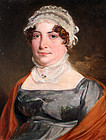
Portrait of a Woman in Lace Cap Oil on panel. Provenance: J. Davey & Sons, Manchester, England
Painting size: 8.5” x 7”
Prints : Lithographs : Pre 1900
item #1195365
(stock #RMT-134)
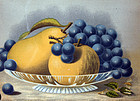
Tabletop Still Life with Fruit
A lithograph by C.H. Crosby & Co., 1874, in a folk art carved frame.
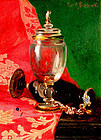
Print size: 5.25” x 7.5” Tabletop Still Life with Glass Vases
Henri Dominique Roszezewski (French, 19th/20th century) Oil on panel, signed. A painter of landscapes and still lifes, Roszezewski studied under Maillard. He made his debut at the Salon de Paris in 1868 and was particularly noted for his still life paintings.
Roszezewski is listed in Dictionnaire des Peintres, Sculpteurs, Dessinateurs, et Graveurs by Bénézit.
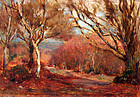
Painting size: 8.5” x 6.25” John White
(English, 1851-1933)
Woodland Fall Landscape Oil on panel, signed in lower left corner, “JN White, R.I.”
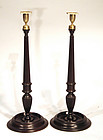
Painting size: 6.75” x 10” Known for his rustic genre paintings and landscapes, White attended the Royal Scottish Academy. By 1877, he moved to Devon and exhibited regularly at the Royal Academy, the Society of British Artists, Suffolk Street and the New Watercolor Society. On this landscape, White painted the initials “R.I.” after his name, indicating that he was a Member of the Royal Institute of Painters in Watercolors. Although this work is in oil, White’s scumbled brushwork has the immediacy of watercolor and creates the atmospheric haze of a fall afternoon. John White was also a Member of the Royal Institute of Painters in Oil-Colors. He is listed in The Dictionary of British Watercolor Artists up to 1920 (Mallalieu, 1976) and the Dictionary of British Art, Volume IV Victorian Painters (Wood, 1995). Fine Large Pair of Regency Wood and Brass Candlesticks with fluted shafts and turned, circular bases. English, 1800-1820
Height: 21.5"
| |||||||||||